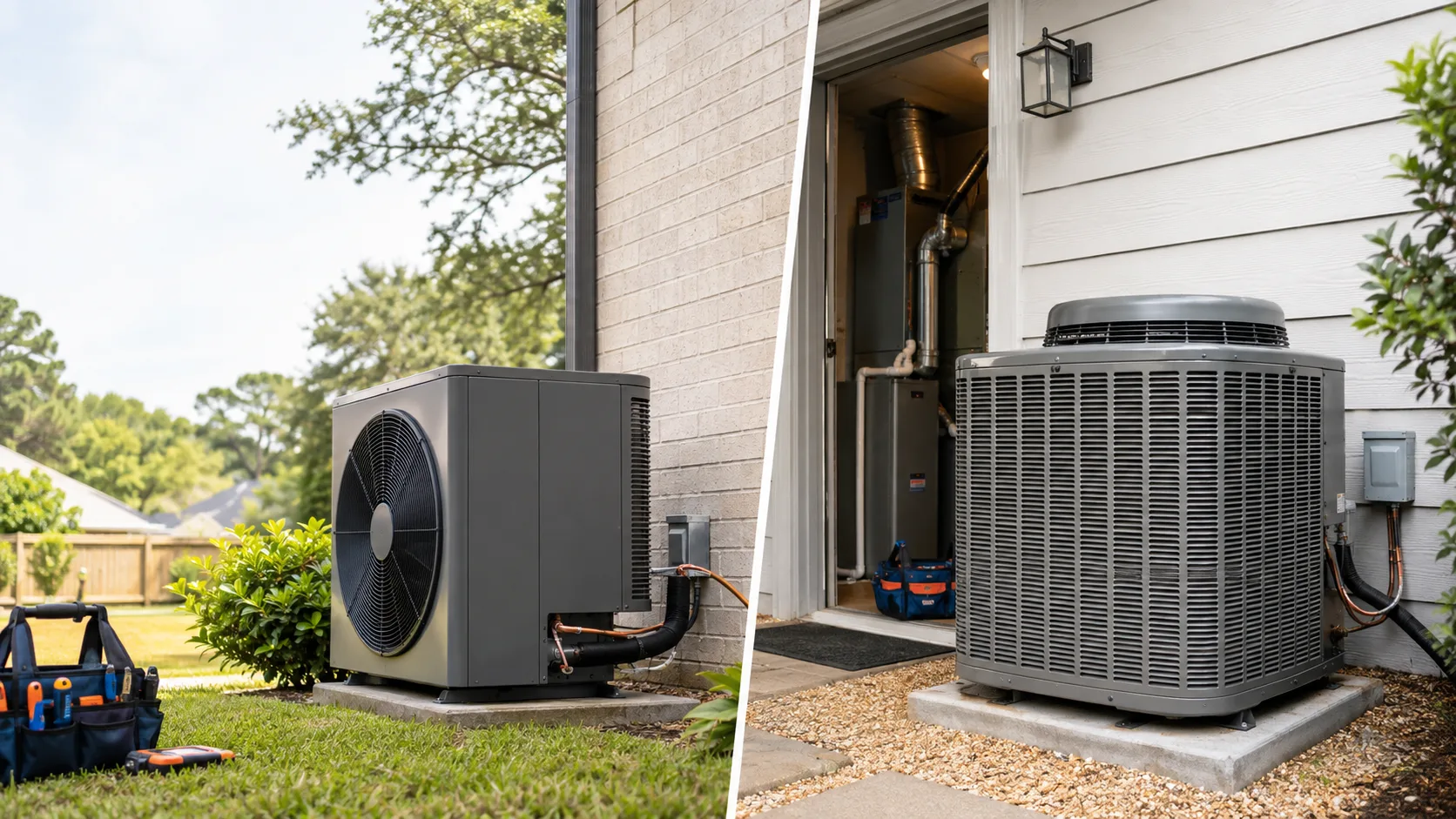
A heat pump and a central air conditioner can look similar outside, but the heat pump can reverse operation to provide heating. The meaningful Houston comparison includes the existing heat source, electrical capacity, indoor equipment, controls, backup-heat strategy, ducts, load, comfort priorities, and complete installed scope. Equipment labels alone do not predict operating cost or comfort.
Editorial standard: This guide explains decision factors and safe preparation. It does not prescribe work remotely, promise a price, or replace equipment-specific diagnosis.
01 / FIELD GUIDE
What heat pumps versus central air means for a Houston property
The comparison is between complete heating-and-cooling systems and ownership outcomes, not two outdoor boxes with similar nominal capacity. The useful question is not which part is mentioned most often online. It is which condition can be demonstrated on this installed system, under the operating circumstances that produced the complaint. Two properties can report the same outcome while requiring completely different work because equipment, controls, air distribution, moisture load, access, and service history differ.
Start by describing when the condition appears, how long it lasts, which rooms or business zones are affected, and what changed before it began. Weather, occupancy, thermostat schedule, maintenance, renovation, a power event, or another repair can all change the context. This timeline helps a technician choose tests; it does not replace those tests or turn an observation into a remote diagnosis.
- existing furnace or electric heat
- winter and summer load
- utility structure
- electrical capacity
- humidity and staging
- duct and control compatibility
02 / FIELD GUIDE
Safe checks before requesting Houston HVAC service
Do not test heating by forcing repeated mode changes or opening equipment; document how the current system heats, thermostat wiring, and any cold-weather comfort or breaker concerns. A homeowner or site contact can usually confirm thermostat mode and setpoint, note whether indoor and outdoor equipment respond, look at an accessible filter, and record visible messages without removing panels. A commercial contact can also identify the served zone, equipment tag, current schedule, and whether a building-control alarm appeared.
Stop operation for smoke, a burning odor, repeated breaker trips, severe grinding or electrical noise, active water near electrical parts, ice that blocks airflow, or another unsafe condition. Do not bypass switches, reset a breaker repeatedly, open energized compartments, climb onto a roof, enter an unsafe attic, or handle refrigerant components. Immediate life-safety concerns belong with emergency services or the appropriate utility.
- Record the symptom without dismantling equipment
- Protect people and property before comfort
- Keep model-label photos at a safe distance
- Note the time, weather, and thermostat state
03 / FIELD GUIDE
The diagnostic sequence for heat pumps versus central air
A defensible diagnostic path moves from demand to delivery. Depending on the equipment and symptom, the visit may examine current cooling and heating performance, building load, duct pressure and distribution, indoor-outdoor equipment pairing, controls and stages, electrical service, and backup heat and defrost needs. The technician should connect each reading to the operating sequence rather than collect numbers without explaining why they matter. If the complaint cannot be reproduced, history and stored fault information become more important, and the limitation should be documented.
Diagnosis also asks whether the apparent failure is primary or consequential. A safety may open because it is defective, but it may also be correctly responding to restricted airflow, overheating, blocked drainage, unstable power, or another condition. Replacing the device that reports a problem without finding what triggered it can create a repeat visit and may remove important protection.
- current cooling and heating performance
- building load
- duct pressure and distribution
- indoor-outdoor equipment pairing
- controls and stages
- electrical service
- backup heat and defrost needs
04 / FIELD GUIDE
Airflow, ducts, and building load behind heat pumps versus central air
HVAC equipment operates inside an air-distribution and building system. The relevant checks can include required airflow by stage, return and supply capacity, duct losses, room distribution, blower capability, and latent performance at lower output. A clean-looking register does not confirm adequate airflow, and a powerful outdoor unit cannot overcome a collapsed branch, restrictive return, dirty blower, uninsulated attic duct, closed room path, or load that was never included in the original design.
Room use matters as well. West-facing glass, an added home office, cooking, electronics, high occupancy, exterior-door traffic, or a converted garage can change the load. Air distribution should be evaluated against those conditions before equipment capacity is blamed. Closing registers or installing a larger unit without pressure and load context may make noise, cycling, moisture removal, or reliability worse.
- required airflow by stage
- return and supply capacity
- duct losses
- room distribution
- blower capability
- latent performance at lower output
05 / FIELD GUIDE
Thermostat and control factors that change the diagnosis
The thermostat is one point in the control chain. Diagnosis may need to consider reversing-valve logic, heat-pump thermostat setup, auxiliary heat staging, outdoor lockouts, defrost sensors, and communicating or variable controls. A display can appear normal while a control signal, sensor, safety, schedule, stage configuration, transformer, or communicating connection prevents the expected response. Smart features add useful data but also add setup and network variables that must be separated from mechanical performance.
Document the settings that existed when the problem appeared before changing every menu. For staged or variable equipment, short periods at lower output can be normal, while repeated aborted starts or missing stages may require investigation. For heat pumps, reversing-valve setup, auxiliary heat, outdoor sensors, and defrost behavior can change what the occupant feels at a register.
- reversing-valve logic
- heat-pump thermostat setup
- auxiliary heat staging
- outdoor lockouts
- defrost sensors
- communicating or variable controls
06 / FIELD GUIDE
How a Houston HVAC repair scope should be written
When a fault is verified, the scope should name the condition and the work intended to correct it. For this topic, that may involve mode-specific controls, reversing or defrost components, indoor airflow, electrical circuits, refrigerant-side correction, and backup-heat components. It should state parts or materials, access assumptions, related cleaning or adjustment, refrigerant or electrical steps where relevant, exclusions, and the functional checks planned after the repair. A part name without a complete work sequence is difficult to compare.
Separate immediate restoration from optional improvements. An urgent repair may restore safe operation while duct correction, filtration changes, insulation, controls, or planned replacement remain separate decisions. Conversely, a component repair may be poor value when another documented condition would continue to damage it. The customer should be able to see which finding supports each line of the proposal.
- mode-specific controls
- reversing or defrost components
- indoor airflow
- electrical circuits
- refrigerant-side correction
- backup-heat components
07 / FIELD GUIDE
When to compare HVAC repair with replacement
Replacement is not proved by age alone, and repair is not automatically economical because a system can be restarted. A balanced comparison considers complete installed price, heating fuel changes, electrical upgrades, equipment match, incentive eligibility, maintenance and repair support, and projected use based on defensible assumptions. It also considers how long the owner expects to keep the property, whether comfort problems predate the current failure, and whether a partial replacement can remain properly matched and supported.
Ask for comparable scopes. A replacement proposal should address load, indoor and outdoor equipment, controls, airflow, drains, electrical coordination, line-set condition, equipment access, permits where applicable, removal, startup, commissioning, and written warranty terms. A repair proposal should explain what is restored, what remains unchanged, and what uncertainty cannot be removed until work or disassembly occurs.
- complete installed price
- heating fuel changes
- electrical upgrades
- equipment match
- incentive eligibility
- maintenance and repair support
- projected use based on defensible assumptions
08 / FIELD GUIDE
Houston heat and humidity considerations
Houston conditions change the weight of the decision. Relevant factors include long cooling demand, mild but variable winters, occasional cold fronts, humidity removal, shoulder-season cycling, and power and storm resilience planning. Extended runtime in hot weather is not automatically a defect; it can be the way properly sized equipment responds to peak load. But declining temperature control, rising indoor moisture, freezing, repeated safeties, water overflow, or unusual electrical behavior deserves investigation.
Moisture performance depends on coil temperature, airflow, runtime, equipment staging, thermostat behavior, infiltration, ventilation, duct leakage, and indoor sources. Oversizing can shorten cycles, but size is only one cause of humidity complaints. Likewise, attic heat can magnify supply losses and return leakage. A Houston solution should connect climate to measurements rather than use climate as a generic sales line.
- long cooling demand
- mild but variable winters
- occasional cold fronts
- humidity removal
- shoulder-season cycling
- power and storm resilience planning
09 / FIELD GUIDE
Property and access details that affect the work
The same technical problem becomes a different project across all-electric homes, homes with gas furnaces, renovated houses, townhomes with space limits, rentals with utility allocation, and light-commercial spaces. An occupied home may require pet coordination and floor protection. A rental adds tenant, owner, and manager roles. A rooftop unit adds roof authorization and weather limits. A restaurant, office, or warehouse adds shutdown windows, business impact, site safety, and approval procedures.
Submit the exact address and ZIP, equipment location, gate or parking directions, unit or suite, roof or attic rules, and the approving contact. These facts help plan the right visit. They do not guarantee coverage or an arrival time. When another trade controls electrical distribution, gas service, roofing, drainage, structure, environmental testing, or building automation, that boundary should be named early.
- all-electric homes
- homes with gas furnaces
- renovated houses
- townhomes with space limits
- rentals with utility allocation
- light-commercial spaces
10 / FIELD GUIDE
How to prepare for a productive HVAC visit
Collect recent utility use, heating fuel, equipment labels, breaker information, thermostat model, room complaints, and renovation or insulation plans. Gather model and serial photos if safely accessible, prior service records, filter information, thermostat screenshots, utility-use comparisons, error codes, and a short timeline. Avoid cleaning away evidence such as water patterns or resetting every fault immediately before the visit, unless safety or property protection requires shutdown.
Make the equipment and affected rooms accessible, secure pets, identify fragile surfaces, and tell the service provider about ladders, roofs, tenants, alarms, or restricted hours. In a commercial setting, name the equipment tag and zone, and arrange an escort when required. Good preparation reduces avoidable delay; it does not predetermine the diagnosis.
- Current heating fuel and equipment
- Cooling and winter complaints
- Electrical panel context
- Duct and room issues
- Comparable full-system proposals
11 / FIELD GUIDE
Questions to use when comparing HVAC proposals
Require both options to state indoor and outdoor equipment, heating strategy, controls, electrical and duct changes, commissioning, warranty, and assumptions used for any operating-cost estimate. Ask what was verified, which readings support the conclusion, what the scope includes, what remains uncertain, whether related airflow or control conditions were considered, and how completion will be tested. If a price differs sharply, compare access, materials, system matching, commissioning, exclusions, and warranty language rather than only the total.
Claims deserve documentation. Confirm the legal business identity, appropriate Texas licensing information, insurance wording, permit responsibility, manufacturer or dealer status, labor and part warranty terms, payment schedule, financing terms, and cancellation rights where applicable. A website badge or verbal assurance should not substitute for the current document relevant to the actual contractor and job.
- What condition did the testing verify?
- What is included and explicitly excluded?
- What could change the price after approval?
- Which readings will confirm the finished result?
12 / FIELD GUIDE
Verification and follow-up after the HVAC work
Completion should return to the original complaint. Appropriate verification may include cooling operation, heating and auxiliary stages when weather permits, defrost controls, airflow by applicable stage, thermostat configuration, and documented startup. The exact readings depend on equipment, mode, weather, and scope; a single universal number should not be promised. The closeout should identify what was changed, what was tested, and which condition could not be evaluated.
Keep invoices, model information, commissioning records, photos, filter sizes, warranty documents, and recommended observation points. Monitor the symptom under similar conditions and report recurrence with dates and settings. Follow-up is more effective when it compares the original evidence with post-work operation rather than beginning again with a vague description.
- cooling operation
- heating and auxiliary stages when weather permits
- defrost controls
- airflow by applicable stage
- thermostat configuration
- documented startup
13 / FIELD GUIDE
Common mistakes to avoid with heat pumps versus central air
Common shortcuts include comparing outdoor-unit prices only, assuming a heat pump never needs backup heat, ignoring electrical capacity, projecting savings from one utility bill, and preserving incompatible indoor equipment. These choices feel decisive because they name a product or action quickly, but they may leave the causal condition unchanged. A sound plan preserves uncertainty until testing earns a conclusion and then translates that conclusion into a scope a customer can understand.
The goal is not the largest checklist or the longest proposal. It is a traceable line from symptom to evidence, from evidence to recommendation, and from approved work to verification. That line is especially valuable in Houston, where heavy cooling demand can make more than one marginal condition appear at the same time.
- comparing outdoor-unit prices only
- assuming a heat pump never needs backup heat
- ignoring electrical capacity
- projecting savings from one utility bill
- preserving incompatible indoor equipment
SERVICE PREPARATION
Heat Pump vs Central Air checklist
QUESTIONS
Heat Pump vs Central Air FAQ
Is a heat pump automatically cheaper to operate in Houston?+
No. Outcome depends on equipment efficiency and staging, weather, utility rates, backup heat, controls, duct losses, setpoints, building load, and current system condition. Estimates should state assumptions rather than promise a percentage.
Can an HVAC issue be diagnosed from a photo or phone call?+
Photos and a precise history can identify equipment and help route a visit, but most repair conclusions require safe access, operating observations, and measurements. A remote conversation should not be used to promise a part or refrigerant quantity.
Does this guide replace an on-site HVAC inspection?+
No. It is a decision guide for Houston property owners and managers. Equipment-specific safety procedures, manufacturer information, applicable requirements, and a qualified field diagnosis control the actual work.
What should a Houston HVAC proposal document?+
It should identify the equipment and verified condition, included work, materials or parts, access assumptions, exclusions, approval terms, and the checks used to verify completion. Any warranty, schedule, permit, or price term should be written for the job.