Houston service overview
Commercial HVAC service starts with the installed condition
Commercial service must connect mechanical findings to business operations. Access rules, roof safety, tenant zones, operating hours, shutdown limits, controls, equipment redundancy, procurement, and approval authority all affect how a job is diagnosed and scheduled.
The request should connect the system behavior with the building and the people who use it. Note when the condition appears, which rooms or zones are affected, thermostat settings, equipment location, maintenance or repair history, and any safe observations of water, ice, sound, odor, or error messages. These details improve routing, but they do not replace qualified field testing.
A reliable visit distinguishes an immediate safety or property-protection need from the work required to diagnose performance. It also records access limitations. Locked roofs, extreme attic conditions, occupied units, concealed ducts, weather, or equipment that cannot operate can change which conclusions are available during the first visit.
01 / DIAGNOSIS
What Houston commercial hvac service checks
The exact sequence depends on the equipment and symptom. These checkpoints define the intended investigation without claiming that every test is required for every system.
Equipment inventory, served areas, controls, and active alarms
Roof or mechanical-room access and site safety requirements
Filters, coils, drains, belts where present, electrical condition, and operating sequence
Business impact, critical zones, and acceptable shutdown windows
Measurements only help when interpreted with operating mode, outdoor and indoor conditions, equipment documentation, and the original complaint. A number collected after an automatic safety has stopped a component may describe the consequence rather than the cause. The diagnostic record should explain that relationship in plain language.
02 / SCOPE
How the commercial hvac scope is defined
A scope should identify the verified condition, the work intended to change it, access assumptions, included parts or materials, exclusions, and how completion will be checked. This lets a customer compare outcomes rather than comparing two totals that may represent different work.
- 01
Name the affected equipment and operational priority
- 02
Separate restore-now actions from planned reliability work
- 03
Provide documentation suitable for the site contact or approval process
- 04
Coordinate access, parts, shutdown, and post-work verification
Price, schedule, part availability, warranty, permits, and response commitments must be confirmed for the actual job. This page intentionally does not use an unverified coupon, flat price, guaranteed arrival window, or universal performance claim to manufacture urgency.
03 / DECISIONS
Repair and replacement decisions for commercial hvac
The purpose of diagnosis is not to force every request toward one predetermined sale. The useful outcome is a defensible choice that reflects verified condition, risk, compatibility, comfort, property operations, and the owner’s time horizon.
Comfort calls can originate in zoning, schedules, sensors, tenant changes, or building load
Repeated reset-and-run visits do not replace root-cause diagnosis
Maintenance scope should reflect equipment count and use
Capital planning benefits from consistent condition records
When replacement is considered, ask whether the comparison covers load, humidity control, indoor and outdoor matching, ducts, controls, drainage, electrical work, equipment access, commissioning, permits where applicable, and written warranty terms. When repair is considered, ask what the work restores and what conditions remain unchanged.
04 / HOUSTON CONTEXT
Houston conditions that affect commercial hvac
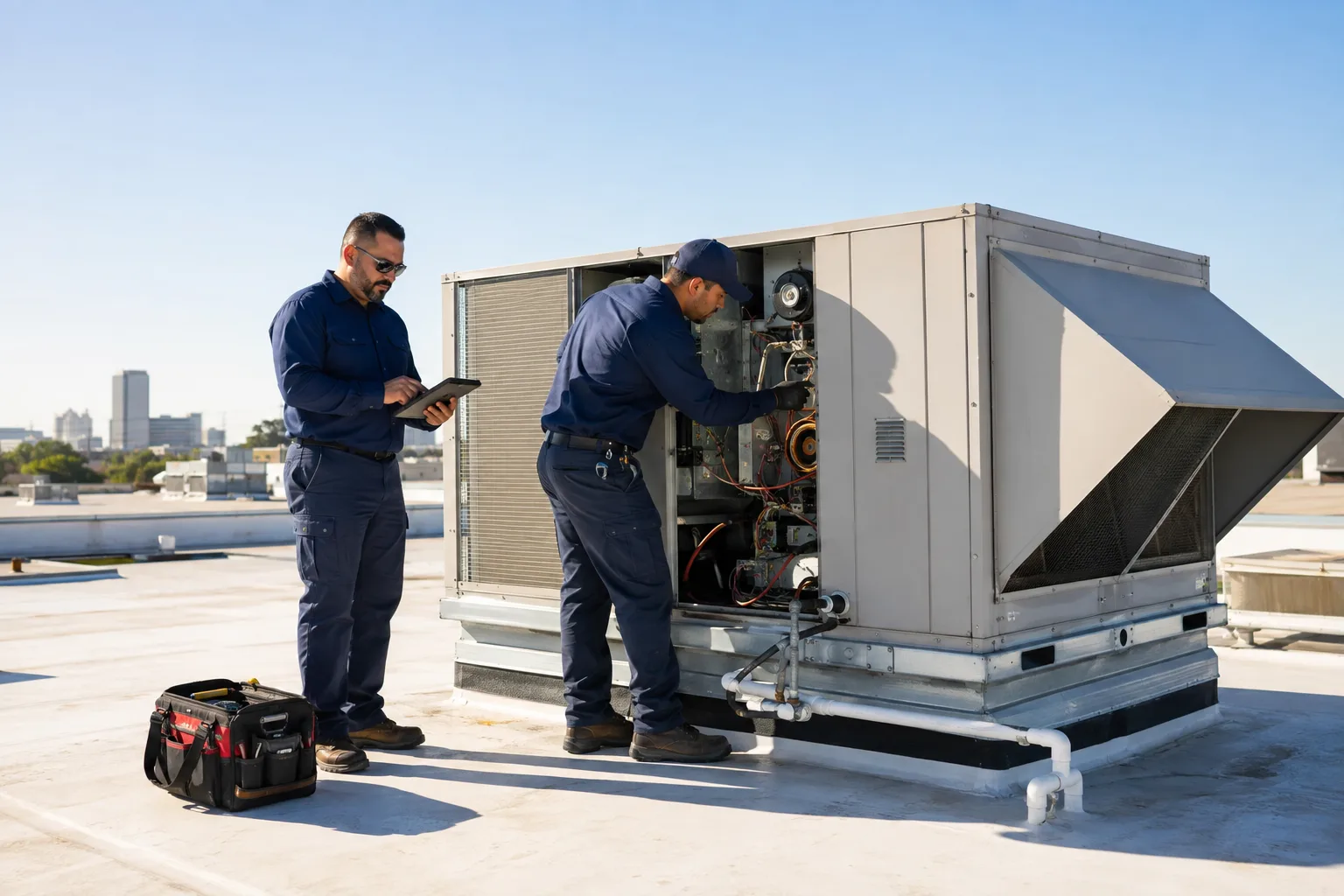
Houston commercial roofs add solar heat, storms, windblown debris, drainage exposure, and difficult summer working conditions. Scheduling and safety planning are part of the service scope, not administrative afterthoughts.
Neighborhood and climate context helps plan the visit; it cannot establish equipment condition. Exact address, ZIP code, property access, and the installed system remain necessary before coverage, schedule, or scope is confirmed.
05 / LIMITS
What this service page does not promise
- Roof access, certificates, escorts, insurance, and after-hours rules must be confirmed
- No uptime or response-time guarantee is made without a signed service agreement
- Building automation, specialty refrigeration, fire systems, and electrical distribution may require separate providers
06 / QUESTIONS
Commercial HVAC questions from Houston property owners
Can you quote commercial hvac from a phone description?+
A symptom helps route the request, but a defensible scope usually requires equipment identification, access review, measurements, and confirmation of the failed condition. The site does not promise a fixed repair before that work is complete.
Do you serve every Houston ZIP code?+
Coverage and scheduling depend on the exact address, travel window, property access, and service capacity. Send the ZIP code first so availability can be confirmed without implying a local office in every neighborhood.
Will I receive options before work begins?+
The intended workflow is to separate findings from recommendations, describe what each option changes, and obtain approval for the defined scope. Prices, warranties, and availability must be confirmed for the specific job.
What information should I provide?+
Share the property type, equipment location, thermostat behavior, when the issue began, any unusual sound or odor, recent maintenance, and safe photos of the equipment label if available. Never open energized panels to take a photo.