Houston service overview
Indoor Air Quality service starts with the installed condition
Indoor air quality is not a single-device problem. Particle sources, outdoor-air entry, moisture, filtration, pressure relationships, ventilation, housekeeping, envelope conditions, and HVAC runtime interact. Product selection should follow the concern and the measurements available.
The request should connect the system behavior with the building and the people who use it. Note when the condition appears, which rooms or zones are affected, thermostat settings, equipment location, maintenance or repair history, and any safe observations of water, ice, sound, odor, or error messages. These details improve routing, but they do not replace qualified field testing.
A reliable visit distinguishes an immediate safety or property-protection need from the work required to diagnose performance. It also records access limitations. Locked roofs, extreme attic conditions, occupied units, concealed ducts, weather, or equipment that cannot operate can change which conclusions are available during the first visit.
01 / DIAGNOSIS
What Houston indoor air quality service checks
The exact sequence depends on the equipment and symptom. These checkpoints define the intended investigation without claiming that every test is required for every system.
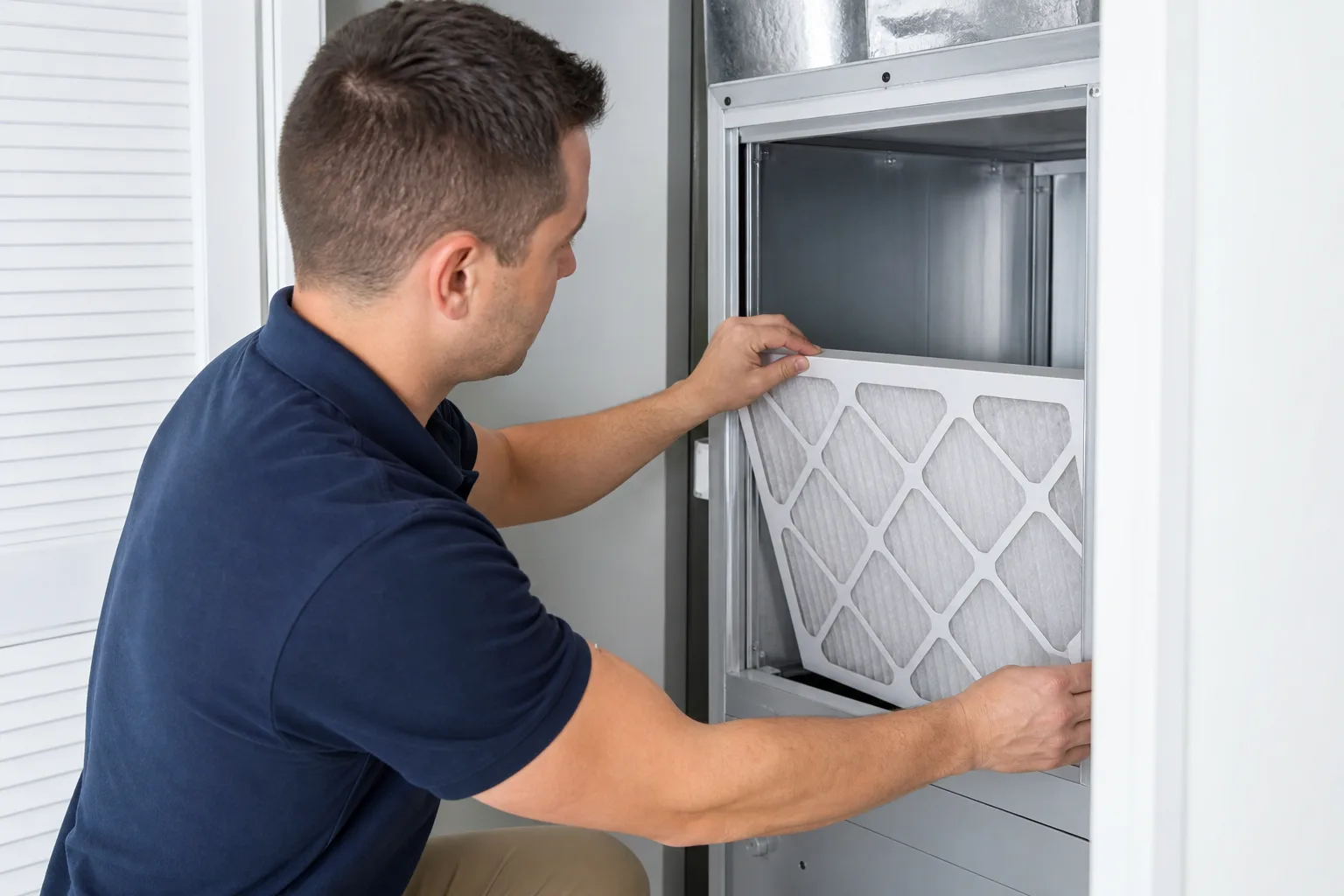
Filter size, fit, condition, cabinet, and pressure implications
Indoor humidity patterns and visible moisture sources
Return-air pathways, ventilation strategy, and equipment runtime
Specific occupant concerns without making medical diagnoses
Measurements only help when interpreted with operating mode, outdoor and indoor conditions, equipment documentation, and the original complaint. A number collected after an automatic safety has stopped a component may describe the consequence rather than the cause. The diagnostic record should explain that relationship in plain language.
02 / SCOPE
How the indoor air quality scope is defined
A scope should identify the verified condition, the work intended to change it, access assumptions, included parts or materials, exclusions, and how completion will be checked. This lets a customer compare outcomes rather than comparing two totals that may represent different work.
- 01
Define the concern: particles, odor, humidity, ventilation, or equipment cleanliness
- 02
Correct obvious fit, bypass, drain, or airflow defects first
- 03
Compare filtration or humidity-control options with system limits
- 04
State maintenance requirements and replacement consumables
Price, schedule, part availability, warranty, permits, and response commitments must be confirmed for the actual job. This page intentionally does not use an unverified coupon, flat price, guaranteed arrival window, or universal performance claim to manufacture urgency.
03 / DECISIONS
Repair and replacement decisions for indoor air quality
The purpose of diagnosis is not to force every request toward one predetermined sale. The useful outcome is a defensible choice that reflects verified condition, risk, compatibility, comfort, property operations, and the owner’s time horizon.
Higher filter ratings can increase restriction if the system cannot support them
UV equipment is not a substitute for moisture correction or filtration
Odor does not identify a contaminant by itself
HVAC service is not environmental testing or medical advice
When replacement is considered, ask whether the comparison covers load, humidity control, indoor and outdoor matching, ducts, controls, drainage, electrical work, equipment access, commissioning, permits where applicable, and written warranty terms. When repair is considered, ask what the work restores and what conditions remain unchanged.
04 / HOUSTON CONTEXT
Houston conditions that affect indoor air quality
Houston outdoor humidity, flooding history, long cooling seasons, attached garages, attic returns, and tightly closed homes all influence the investigation. Moisture control should consider sources beyond the thermostat display.
Neighborhood and climate context helps plan the visit; it cannot establish equipment condition. Exact address, ZIP code, property access, and the installed system remain necessary before coverage, schedule, or scope is confirmed.
05 / LIMITS
What this service page does not promise
- Suspected mold, combustion gases, asbestos, or hazardous materials require appropriately qualified professionals
- Health symptoms should be discussed with a healthcare professional
- No device is described as eliminating all particles or pathogens
06 / QUESTIONS
Indoor Air Quality questions from Houston property owners
Can you quote indoor air quality from a phone description?+
A symptom helps route the request, but a defensible scope usually requires equipment identification, access review, measurements, and confirmation of the failed condition. The site does not promise a fixed repair before that work is complete.
Do you serve every Houston ZIP code?+
Coverage and scheduling depend on the exact address, travel window, property access, and service capacity. Send the ZIP code first so availability can be confirmed without implying a local office in every neighborhood.
Will I receive options before work begins?+
The intended workflow is to separate findings from recommendations, describe what each option changes, and obtain approval for the defined scope. Prices, warranties, and availability must be confirmed for the specific job.
What information should I provide?+
Share the property type, equipment location, thermostat behavior, when the issue began, any unusual sound or odor, recent maintenance, and safe photos of the equipment label if available. Never open energized panels to take a photo.